Thursday, February 1, 2007

It's Still Not Too Late To Stop The Craziness

Just because I decided to go all in doesn't mean you should.

If you've done your book the right way and hired a professionally good illustrator you've spent a few thousand dollars at least up to this point. Not to mention all the time and anxiety you've put yourself and others through.

I read a column the other day that was so true about Americans in general. It was in reference to George Bush. The gist was that most people can't seem to make the decision to cut their losses even if there's no reasonable chance of success. Pride takes over and bad decisions become horrible decisions.

The idea that you can't stop now because of all the money and time you've put in is faulty logic if the chances for success are bleak.

You still have to pay someone to format the book, print the book, ship the book and if it hasn't been executed at a top professional level nothing you do can make it successful. Much more money will have to be spent just to sell a book.

So if you want to get 1,500 children's books printed for some other reason that to get your money back then go ahead. But the old saying don't throw good money after bad is very true.

Smart, successful business people can make that tough decision but generally people like us who are caught up in the allure of being in the book business can't.

Michael LaLumiere


Monday, January 29, 2007

"Birthday Snow'' Attempt No. 2

So my first printing - I mean test - didn't go so well.

I had a soft cover color picture book with only average color that I would have to sell for $14.95. That was never going to happen. Even my mother said, "Nice dear, but too bad it doesn't have a hard cover, it would look more professional.''

Fine.

Fortunately - I thought - LuLu started doing hard covers. I charged ahead. Better result. But it still wasn't Book Store quality. The worst thing though was it cost $21 per book to produce through LuLu. Picture books range from $14 to $17 retail. That was a non-starter.

That forced me to finally look at printing the book myself. Book printers insist you order a minimum of 1,000 to 1,500 books. The reason is it's hardly worth it to them to start up the press to only do that few. U.S. printers were too expensive. Overseas you could get it done for $2.50 to $3 a book at a 1,500 minimum press run.

Decision time. Was this book good enough for that kind of investment? Would I be stuck with a lot of books? Did I care that I would lose money? Why was I really doing this? Was I just a legend in my own mind?

I went in the tank. In no-limit hold 'em poker that's what you do when somebody goes all in and you have to decide what the hell you're going to do. You sit there trying to think of all the probabilities and either decide to throw all your money in or just fold and wait for some other hand.

I went all in.

Michael LaLumiere


Thursday, January 25, 2007

My Early Book Production Errors

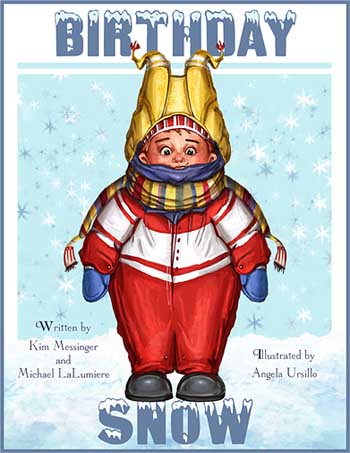
I've just received a pallet of shiny new "Birthday Snow'' books that I wrote with writing partner Kim Messinger.

The books look great. You can see the cover at the bottom of this blog.

It reminds me of all the production problems I had with the first attempt at printing this book. That was when I was publishing books at LuLu. LuLu is a POD company and they served me well for non-color books but I knew that I was in for headaches when it came to trying a full-color picture book. Of course I can now see that it was an excellent testing experience but to be totally honest back then I was a brand new newbie so I knew success was just around the corner. I didn't need no stinkin testing.

Back then LuLu couldn't do hard covers on books with 32 pages. I charged ahead anyway. End papers weren't possible. End papers are the inside front cover and inside back cover. A children's book needs to have some artwork there not a totally white, blank page. For some reason I left in another blank page before the first page of the book. Then I screwed up the copyright page.

That's not all. On a couple pages the color hid the text. In preproduction I had the feeling that was going to happen. LIFE LESSON: WHENEVER YOU THINK SOMETHING IS WRONG IN PRODUCTION, 95 PERCENT OF THE TIME IT IS WRONG. (This does not apply to crazy people like my co-writer.)

Just change it and move on.

Oh and the big one. I had a big fat typo right in the middle of the book. It took two more production runs to fix it. A picture book is only 32 pages and has very little text. A professional cannot let a typo through like I did. Several of us read it but as the publisher I'm responsible.

It wasn't a misspelled word, it was a word than had an ing on it when it shouldn't have. Can't let that happen. Don't ever think spellchecker is going to save you.

The good news is if you sell your manuscript to a publisher you don't have to worry about the production, art, artists, etc. The publisher does that. If you're going to self-publish it's all on you baby. My eighteen years of production/publishing experience didn't look so formidable after that first try at a book.

Michael LaLumiere

Monday, January 22, 2007

Update On Self-Publishing Projects

As I write this, a pallet of my "Birthday Snow'' books is in a truck somewhere between Los Angeles and Phoenix. The books had been in a container on a huge ship crossing the Pacific. I'll have them available for sale next week.

The next children's picture book, "A Song For A Giraffe'' is sitting on Ginger Nielson's drawing table being illustrated. It's going to look great. Perhaps in a couple weeks we can post an example of what it's going to look like.

Then there's the novel - "Why is Crater Lake So Blue.'' A designer is working on the cover. A copy editor is working on the text. I'm suppose to be figuring out the marketing plan.

I haven't done any marketing for the children's books. More than a 100 of the first picture book - "Princess Caitlin's Tiara'' - have been sold. Just by placing them in a couple independent book stores and using them for fundraising with a couple non-profit organizations. But no serious effort really.

I can't imagine anything harder than marketing a self-published children's picture book. I don't do school visits, etc. However, I think I can take a good swing at marketing the novel. And use that success - hopefully - as a platform for introducing the children's book. We'll see. Everybody out there in marketing is shaking their head no.

We'll see.

Until then my young niece Morgan is my VP of sales and she's doing just fine.

Michael LaLumiere

Thursday, January 18, 2007

I've Got The Illustrations, I Have The Words, Now What

A lot of beginning self-publishers think the Holy Grail is getting their book on Amazon.

Nope. Just another sad bus station on the selling-your-own-book highway. Almost anybody with an ISBN number can get listed on Amazon with a picture of their very own book cover. Amazon has several ways a self-publisher can do this. But the bottom line is if your target market doesn't know it's there, well, you'll be one of about a million people selling one book a month.

That gets me back to my first publishing attempt. As a newbie I was intrigued by LuLu.com's marketing pitch. Low upfront fees and they have a website where they will sell your book for you. Now there are a thousand print-on-demand (POD) shops and they almost all offer that service.

But it's the same deal as Amazon. If you don't have a very specific niche where you can tell all your built-in customers where to buy, you have a significant problem. Nobody is going to these websites to casually buy a book. So please don't think that will happen. The only way you sell books is by a strong, well-financed marketing plan. Honest. Or if you have that built-in market.

If your doing a full-color children's book the correct reason to use a company like LuLu is for testing. PODs are good places to do many kinds of books but not a full-color children's book. Not yet. The quality isn't there and neither is the price. But it is a cheap way to find out what you did wrong.

But don't make the mistake that I did.

I needed an ISBN number. And at that time I wasn't clear on all the nuances surrounding ISBN numbers. LuLu offered to sell me one so I wouldn't have to figure it out on my own. So I bought one. And the smart guy that I am, I didn't read the fine print.

Turns out LuLu was selling me the number but I didn't own it. I could only use that ISBN number if LuLu was selling the book. They absolutely did not make that clear to me and it really pissed me off because I didn't realize it until I went to publish that book on my own. Caused me problems. That was intentionally disingenious.

There's a lot of that going around in the self-publishing world. That's why you need to fully understand important steps like getting ISBN numbers.

Michael LaLumiere

Monday, January 15, 2007

I'm A Beginner On Something New Almost Every Day

In my last blog I gave beginners a hard time.

But the fact is as I journey through this self-publishing world I become a beginner on some new facet of the business almost every day. Unless your self-publishing for fun or as a hobby it really should be a last resort option for making something a business.

I read a blog the other day from an author who had a 300 book pre-order on his new children's book. That's amazing success. But he was still willing to say that if he knew how much work it would be he wouldn't have done it.

End of today's sermon.

So I needed an illustrator for our first book. In a past life I had hired artists and worked with them for years. So I knew the terrain. The problem was if you're going to have any chance as a self-publisher the product has be as good as the best books at Borders. And in children's picture books the art is obviously pretty darn important.

The Internet made the search a tiny bit easier. I was able to see 3,000 plus portfolios online at various illustrator websites. Out of those 3,000 I wrote down about 10 names.

You have to remember that an artist working for a mid-size publishing house is going to get at least $5,000 for doing a picture book. Those folks have agents. You can't contact them. I wasn't paying that much anyway so there was no way. I contacted a few artists on my list that looked like they were still accepting projects. No I don't work with self-publishers. No I don't work with authors, only editors. No I don't work for that much. If you want a few illustrations I could do that but not a complete picture book. No I'm booked up because I'm so darn good. No, how did you get my email?

So what about those other 2,900 artists? I didn't see my main character in any of those portfolios. There was plenty of skill being demonstrated but as a graphics editor I'm after a look, a tone, a style. Or overwhelming talent. I didn't see it. There is such a big gap between good and professionally good. A lot of struggling artists don't get that. Writers are the same way. But if I don't find a professionally good artist my book is doomed before it's ever published.

For the first time in my adult career I was unable to fill a postion.

In desperation I put an ad in the SCWBI forums saying what I needed and how much I was paying. I really didn't want to do that because it was going to attract other people who were desperate. I was shocked and relieved at how few inquiries I received. A lot of people must have been to that rodeo already and been bucked off the horse.

Luckily for me Angela Ursillo sent me an email. Angela had never done a children's picture book. She was working as a production artist at a film company and wanted to try something else. I saw my main character - Daniel - in her portfolio. She did a professionally good job.

Unfortunately, I was a beginner at being a graphics editor of a children's book. More later.

Michael LaLumiere

Saturday, January 13, 2007

Artists and Writers Working Together Oh My!

So which is harder to work with an artist or a writer?

First I want to say that the two artists who have illustrated my books have worked out very well. I'd work with them again. In fact, one is illustrating a book of mine right now. Whew, that was close.

Actually I should clarify anyway. It's merely DIFFICULT to work with artists and writers. As a long-time editor I occupied the ground between the two and it was always tense. But what's really AWFUL is working with BEGINNING artists and writers. I wouldn't do it. Neither will artists with paying clients. This is business, people.

So let's get back to where we were in the last blog. All you're getting from publishers are rejection form letters. You don't want to spend the $10,000 plus it takes to produce your own professional picture book. And/or you don't know how. What can you do?

If you want to keep moving forward the next step should be a rough dummy of the book. That's what it sounds like - a full-sized paper version of the book using sketches for illustrations. Don't even try and get a professional artist to do this. So many writers go to artist websites asking if they'll do spec work. A professional looks at that email and says 50 percent of 0 royalties is 0. They get mad when you do that.

I'd contact college art programs. Neighborhood artists could do this. The goal is to have something that looks like a book so you can continue to test it. Read it to children. Have parents read it to children. When you have a book to work with it's easier to see what can be improved. The illustrations don't have to be great. It's what you can do to continue moving forward.

Next time I'll talk about how I found artists to do my books.

Michael LaLumiere